For people who think more than they act
Stop overthinking. Start with one question.
MindShift asks you one question a day and answers what you write, with a mind shift from Stoicism or the Bhagavad Gita and one small step you can take today.
Free to download · Android · English
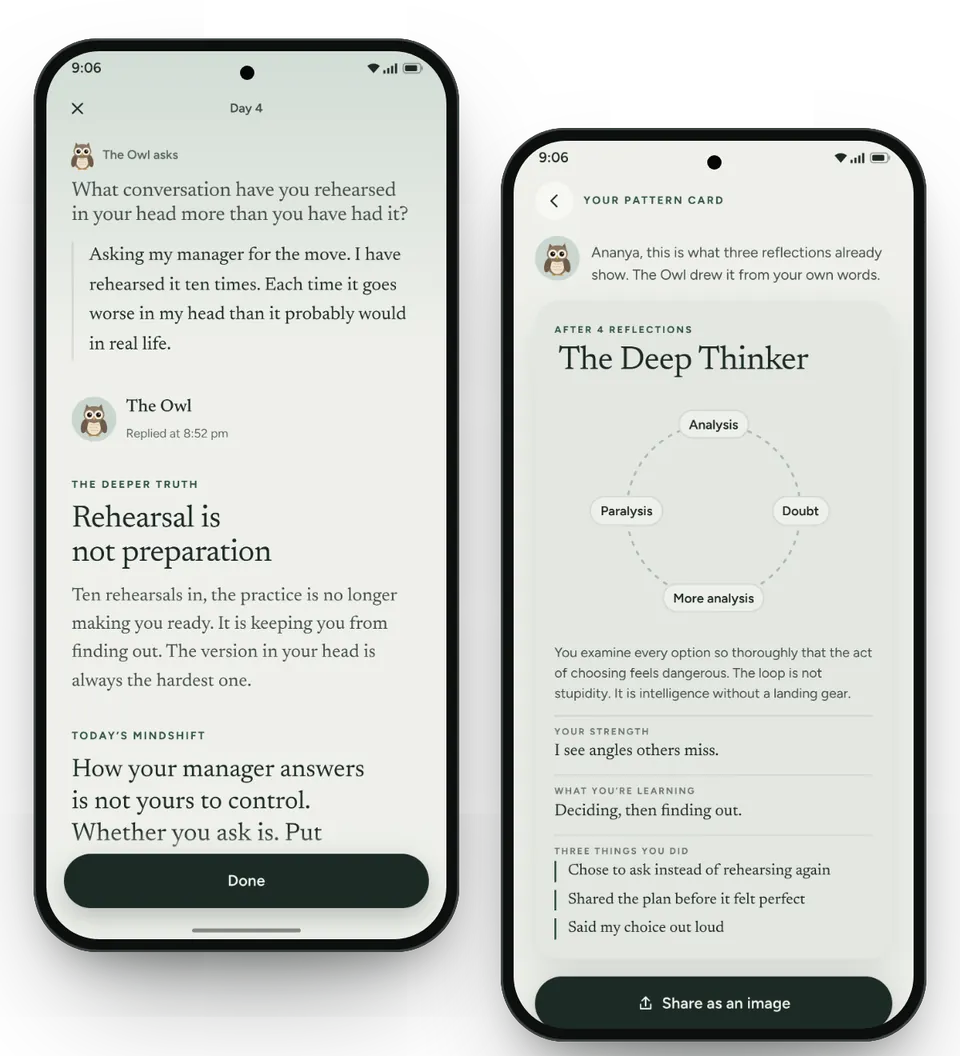
What MindShift is
MindShift is an AI journal for overthinkers, free to download on Android. Each day it asks you one question, built from what you wrote before. You answer in a line or a page, and your guide replies in three parts: the deeper truth about what is going on, a mind shift from the philosophy you chose (Stoicism, Dharma from the Bhagavad Gita, Sufism or Ikigai), and one small step for today.
Who it’s for
People who think more than they act. You replay conversations, rehearse what could go wrong, reopen decisions you have already made, or wait to feel sure before you move. It suits anyone who finds a blank journal page hard to start and wants guidance that is thoughtful rather than generic.
How it’s different
It ends every loop with an action. Free writing can turn into writing the same worry again; a MindShift reply always lands on one small, specific step. Every question builds on your own words, the guidance comes from a philosophy you chose, and a reflection takes about five minutes a day.
How to stop overthinking in five minutes
This is the shape of every MindShift reflection. You can do it on paper tonight.
Name the loop in one sentence.
“I keep replaying what I said in the meeting.” Written down, the loop stops being a fog and becomes something you can look at.
Ask what is really going on.
Overthinking often looks like preparation. Ask what you are afraid will happen if you stop thinking about it. That fear is usually the real subject.
Sort it: yours, or not yours.
The Stoic test from Epictetus: some things are within your power and some are not. Circle the part you can act on. The rest goes on the “not mine” pile.
Choose one small step for the next 24 hours.
Make it so small you cannot argue with it: send one message, write the first line, ask one question.
Close the loop.
Decide when you will come back to it, then stop. The Bhagavad Gita puts it simply: your right is to the action, never to its fruits (2.47).
What a day in MindShift looks like
Five minutes, once a day. The question arrives at the time you choose.
- 1
Take the 2-minute quiz
Seven questions show your thinking pattern and the philosophy that fits you right now.
- 2
Answer one question a day
Each question is built from what you wrote before. A line is enough; a page is fine too.
- 3
Read the reply, take one step
The deeper truth, a mind shift and one small step. After three reflections, your pattern card appears, drawn from your own words.
The Owl asks
What conversation have you rehearsed in your head more than you have had it?
Asking my manager for the move. I have rehearsed it ten times. Each time it goes worse in my head than it probably would in real life.
The deeper truth
Rehearsal is not preparation.
Ten rehearsals in, the practice is no longer making you ready. It is keeping you from finding out. The version in your head is always the hardest one.
Today’s mind shift
How your manager answers is not yours to control. Whether you ask is. Put your energy there, and let the answer be theirs.
“We suffer more often in imagination than in reality.” — Seneca
Signs you are overthinking, not just thinking
- The 3 AM replayAt night your mind reruns a conversation, editing it into a version that will never happen.
- The research spiralYou read about doing the thing instead of doing it.
- The advice loopYou ask several people the same question, hoping someone will decide for you.
- The phantom deadlineYou set a date to decide, it passes, you set another.
If two or more sound familiar, take the 2-minute quiz to see which of the four thinking patterns is yours.
Questions people ask
What is the best app to stop overthinking?
If you want a daily habit rather than a one-off fix, choose a journal that ends in action. MindShift asks one question a day and replies with what is really going on, a mind shift from Stoicism, Dharma, Sufism or Ikigai, and one small step. It is free to download on Android. If you prefer audio, a meditation app can help you slow down; if you like writing freely, a classic journal such as Day One works too.
Can journaling help you stop overthinking?
Yes, especially when an entry ends with a decision. Writing a loop down turns it into something you can look at. The risk is writing the same worry in circles, so use prompts that move you forward, such as “What part of this is mine to act on?”
How long does MindShift take each day?
About five minutes: one question, a few lines from you, and a reply you can read in a minute. A line is enough on busy days.
Do I need to know philosophy?
No. You pick a path in the first minute (Stoicism, Dharma, Sufism or Ikigai), and replies explain ideas in plain words, with a short line from the tradition when it helps.
Is MindShift free?
MindShift is free to download on Google Play. It is on Android now, in English. An iPhone version is not available yet.
Is MindShift the same as MindShift CBT?
No. MindShift is not affiliated with MindShift CBT, a separate app by a different developer. This MindShift is the reflection journal from startmindshift.com, made in India by MindShift Labs.