The Gita as practical philosophy
The Bhagavad Gita, for minds that will not switch off.
Arjuna froze before a decision he could not avoid. The Gita’s answer still works: do your part, and let go of the outcome. MindShift turns it into a five-minute daily practice.
Free to download · Android · English
What MindShift is
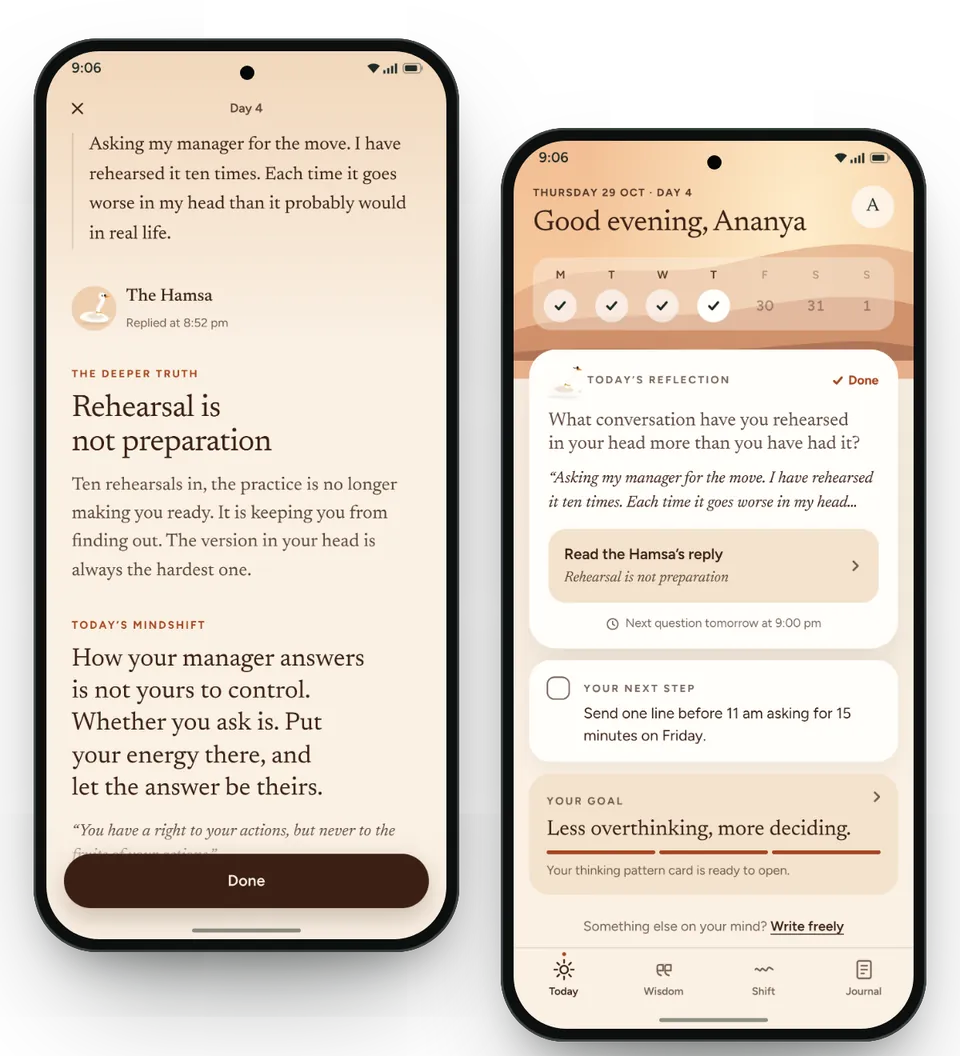
MindShift is an AI journal for Android with a Dharma path drawn from the Bhagavad Gita. Each day it asks you one question, built from what you wrote before. Your guide, the Hamsa, reads your answer and replies with the deeper truth, a mind shift in the spirit of the Gita (do your part, let go of the fruit) and one small step for today. It is free to download on Google Play.
Who it’s for
People who grew up around the Gita, or are curious about it, and want its ideas to help with real decisions: a career move, a conversation you keep postponing, a choice between duty and desire. It is for overthinkers, not scholars. You do not need to be religious or know Sanskrit; replies are in plain English.
How it’s different
It is not a verse-of-the-day app. MindShift starts from your situation and brings in the Gita only where it fits, then ends with one action you can take today. The Gita is treated as practical philosophy about action, choice and a steady mind, and you can switch to Stoicism, Sufism or Ikigai at any time.
Three verses for an overthinking mind
Even Arjuna said it: the mind is restless, turbulent and stubborn, as hard to hold as the wind (6.34). These are the verses MindShift returns to most.
karmaṇy evādhikāras te mā phaleṣu kadācana
You have a right to your actions, but never to their fruits.
Try this: Write down the decision you keep reopening. Circle the one action that is yours to take, and let the result be the result.
dhyāyato viṣayān puṃsaḥ saṅgas teṣūpajāyate
Dwelling on something breeds attachment; attachment, desire; desire, anger; anger, confusion; and confusion clouds judgement.
Try this: The Gita’s map of a spiral starts with dwelling. Notice the first thought you keep returning to; that is the place to interrupt it.
abhyāsena tu kaunteya vairāgyeṇa ca gṛhyate
The mind is restless and hard to hold, but it is steadied by practice and by letting go.
Try this: Practice beats willpower. One small habit, repeated daily, steadies the mind more than one big effort.
For the full set, including 2.48, 2.14, 6.5 and 3.35, read what the Bhagavad Gita says about overthinking.
What a day in MindShift looks like
Five minutes, once a day. The question arrives at the time you choose.
- 1
Take the 2-minute quiz
Seven questions show your thinking pattern and the philosophy that fits you right now.
- 2
Answer one question a day
Each question is built from what you wrote before. A line is enough; a page is fine too.
- 3
Read the reply, take one step
The deeper truth, a mind shift and one small step. After three reflections, your pattern card appears, drawn from your own words.
The Hamsa asks
What conversation have you rehearsed in your head more than you have had it?
Asking my manager for the move. I have rehearsed it ten times. Each time it goes worse in my head than it probably would in real life.
The deeper truth
Rehearsal is not preparation.
Ten rehearsals in, the practice is no longer making you ready. It is keeping you from finding out. The version in your head is always the hardest one.
Today’s mind shift
How your manager answers is not yours to control. Whether you ask is. Put your energy there, and let the answer be theirs.
“You have a right to your actions, but never to the fruits of your actions.” — Bhagavad Gita 2.47
Questions people ask
What does the Bhagavad Gita say about overthinking?
The Gita does not use the word, but it describes the problem closely. Arjuna says the mind is as restless and hard to hold as the wind (6.34). Krishna’s answer is practice and letting go (6.35), and acting without clinging to the result (2.47). In short: do your part well, and let the outcome go.
Which Bhagavad Gita verse helps most with overthinking?
Most people start with 2.47: you have a right to your actions, but not to their fruits. It moves your attention from the result you cannot control to the action you can take.
Do I need to be religious to use the Dharma path?
No. MindShift treats the Gita as practical philosophy about action, choice and a steady mind. People of any background use it, and replies are in plain English.
Is the Dharma path only the Gita?
It leads with the Bhagavad Gita and sometimes draws on the Upanishads, such as the Katha Upanishad’s “Arise, awake, and stop not till the goal is reached.”
Is MindShift free?
MindShift is free to download on Google Play. It is on Android now, in English.
Is MindShift the same as MindShift CBT?
No. MindShift is not affiliated with MindShift CBT, a separate app by a different developer. This MindShift is the reflection journal from startmindshift.com, made in India by MindShift Labs.